

Helical Piles For Foundation Repair
Dose your home need helical piles for foundation repair? Cracks in walls, gaps between windows and walls may indicate a foundation that in under duress. There are several solutions to resolve foundation issues. Stabilizing and lifting the foundation to resolve these issues requires specialized products and certified and skilled technicians.
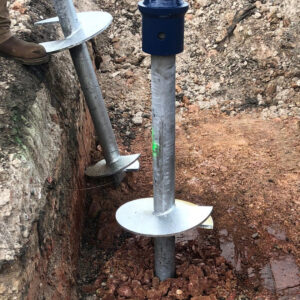
Helical piles look and act much like a screw. They are best suited for reaching very deep load bearing strata. Placing the piles on this strata is needed to stabilize foundations of and size and shape. Helical piles are also commonly known as screw anchors or ground anchors, and they are also excellent for providing support for steps, chimneys, and stairs.
A Few Reasons To Use Helical Piles
- Easy installation
- Little to no vibration caused during installation
- Installation is not typical contingent on weather conditions
- Able to be installed much deeper than active soils
- Little to no disturbance to yard or surrounding landscaping
- Structure load can be immediately transferred upon installation
- Load testing is verified quickly and simply

The Installation
Helical Piles need to be driven deep underground into load-bearing strata. Holes are dug by hand at each point. and chisel the footer in order to make it accessible. A spreader beam is inserted under the foundation and attached to a bracket. Then, a steel pipe is placed into the footer hole, and it’s for the hydraulic torque drive which will drill through the soil. The helical extensions will be inserted until the helical is strongly secured within the soil. After drilling takes place, the extra section of piping is removed. Brackets are placed in specific positions under the spreader beam, and they’re then attached to the footer and the foundation. The foundation is then lifted off the damaged soil and placed onto the helical pile. The process is repeated along the perimeter of the home, the footer hole is filled with soil, and stability is restored to the structure.
Helical piles are excellent in situations where the need exists to resist compression, tension, or even both. Essentially, they’ll raise a home or building back to the elevation it was originally designed for, but it will provide a much greater degree of strength and stability.